Learning Rooms x alulu Article
Are we so obsessed with AI that we have forgotten the humans who actually need to use it?

Are we forgetting the human in AI?
Think about the last quarter century of technology. The internet, the smartphone, GPS. Each one felt sudden, but none of them were. The internet was first conceived in the late 1960s and did not really take off until the early 1990s. Smartphones had their breakout moment in 2007, but it took until around 2012 for widespread use to catch up. People, and the way they worked and learned, had time to adapt.
AI has not given us that time. Since ChatGPT launched in November 2022, the pace of change has barely paused, and it is not the technology that has to keep up. It is the people using it.
We have been here before
This is not the first time a fast moving technology has arrived faster than the people expected to use it could adjust. When automation swept through manufacturing in the 1980s, entire assembly lines were redesigned around machines within a few short years. Workers who had spent decades building genuine craft skill suddenly needed a different kind of skill altogether, one built around overseeing, adjusting and troubleshooting machines rather than operating tools by hand, and the retraining that followed, where it existed at all, rarely matched the speed of the change itself. Adapting was possible. It just was not given the time or the support it needed.
The lesson from that period was never that automation itself was the problem. It was that people needed new skills, with little structured support to help build them. The technology got all the attention.
So where does that leave the person actually doing the work today?
The honest answer is that we do not fully know yet. There is no reliable evidence that AI is wiping out jobs at scale, but there is a quieter risk building underneath that headline. When AI absorbs the routine parts of a role, the skills that used to get built through everyday practice can start to erode, even as expectations to use AI well keep rising. Judgement, critical thinking, confidence and curiosity do not come bundled with a new tool. They are still built the way they always were, through practice, feedback and repetition. That is exactly what gets lost when everything else speeds up.
Leaders want the advantage AI promises, but that advantage still depends entirely on the humans who operate it. This is not a problem that a single training course fixes. If organisations get it wrong at scale, the erosion is not just individual, it is a societal skills gap. Regulation and mandatory training can only ever cover part of the answer. The other part is whether people are actually motivated to keep learning, not just required to.
Why human judgement still matters
AI is confident even when it is wrong. It does not hesitate, it does not flag its own uncertainty in any way that is easy to spot, and a plausible sounding answer looks exactly the same as an accurate one until someone with real judgement checks it. That is the part of the equation that gets missed most often. Confidence in AI is not the same as trust in AI, and the two get confused constantly.
A person who understands the context, who knows what normal looks like in their own work, and who is willing to question an output rather than accept it, is still doing something no model can do on its own. That is not a temporary gap that better AI will eventually close. It is the whole reason a human needs to be in the loop at all. Without it, organisations do not get AI advantage, they get automation bias, where mistakes get waved through simply because a system produced them.
Building that judgement takes deliberate practice, the same as any other skill. People need real cases to work through, room to get it wrong safely, and enough understanding of how these systems actually behave to know where they tend to fail. Skip that and the “human in the loop” becomes a person clicking approve without really checking anything at all.
Why people disengage from learning
Access matters, but it is not the whole story. Even when learning is genuinely available to everyone, it still fails because engagement drops off, because completion feels like a chore, and because the reward for finishing rarely feels close enough to the effort involved. People need a genuine reason to keep going, not just a policy that tells them to, and they need to feel a sense of progress along the way.
Most people are not short of intention. They are short of energy left over at the end of a working day already full of meetings, targets and their own workload, and a course that arrives as one more thing to get through rarely stands a chance against that.
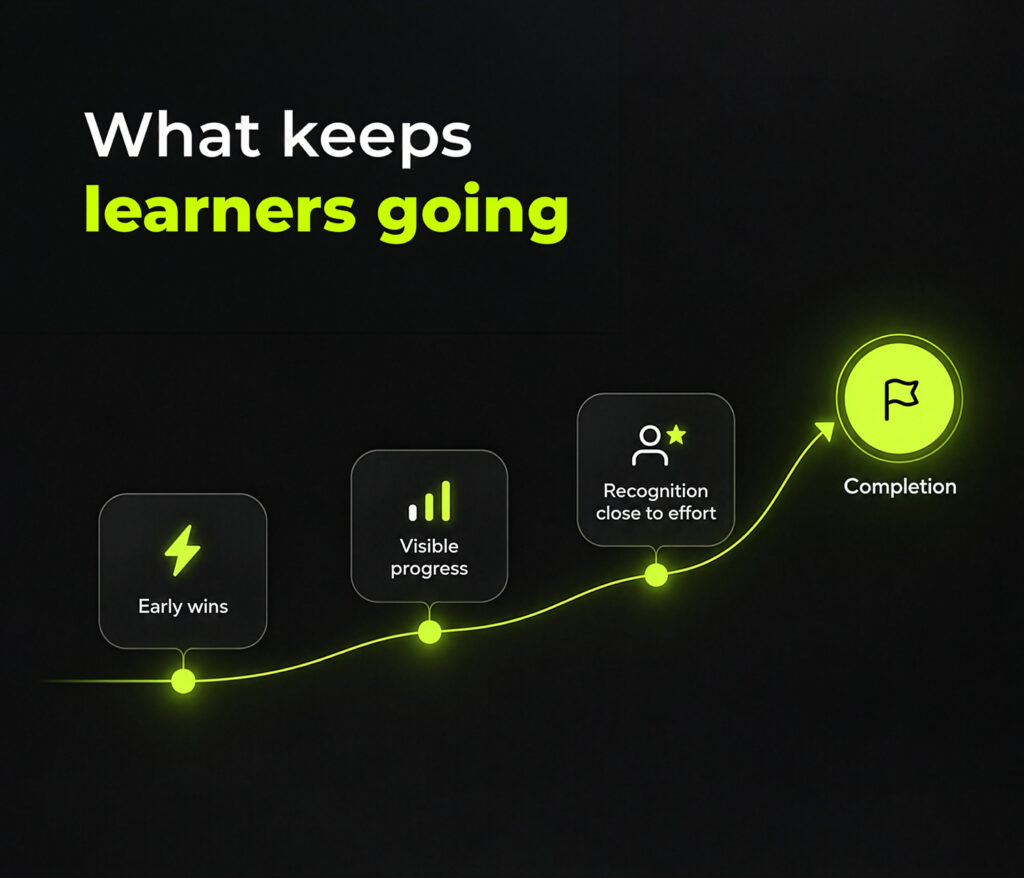
What actually keeps people going is built into how the learning itself is designed and reinforced: early wins that build confidence, progress that is visible rather than hidden in a completion percentage, and recognition that lands close enough to the effort to actually feel like a reward.
Take any one of those away and motivation quietly drains out of even the best designed learning programme.
What human centred AI adoption looks like in practice
None of this needs to be complicated, but it does need to be deliberate. It starts with leaders who are honest that they are figuring this out too, rather than pretending confidence they do not have. It means giving people time to practise with AI on low stakes work before it shows up in anything that matters, and building in the space for people to ask questions and get things wrong without feeling exposed for it. It means measuring whether people can actually use their judgement well alongside the technology, not just whether they logged into a course. And it means asking people what is actually stopping them from engaging, rather than assuming the answer is more mandatory training.
Put the motivation piece and the capability piece together, and the shape of the problem gets clearer.
The technology is not going to slow down to accommodate us. The response has to be people who are supported to keep learning and genuinely motivated to do it. Neither one works well without the other, and the human stays at the centre of both.
Keep this conversation going
This article is a joint piece from alulu and The Learning Rooms.
We are exploring these ideas further in a joint webinar, Learning in the Age of AI: Keeping Humans at the Centre. Register to join the panel discussion and have your say on where the human still fits into an AI shaped workplace.

Real people.
Real perspectives.
A more human future.
 ×
×